Recognition and definition of challenging behaviour in multidisciplinary consultation
How frequent does the challenging behaviour occur, how long does it last, where and when, what time of day, what happens before and after the behaviour, what is the impact on the client and the setting, are there far-reaching life events?
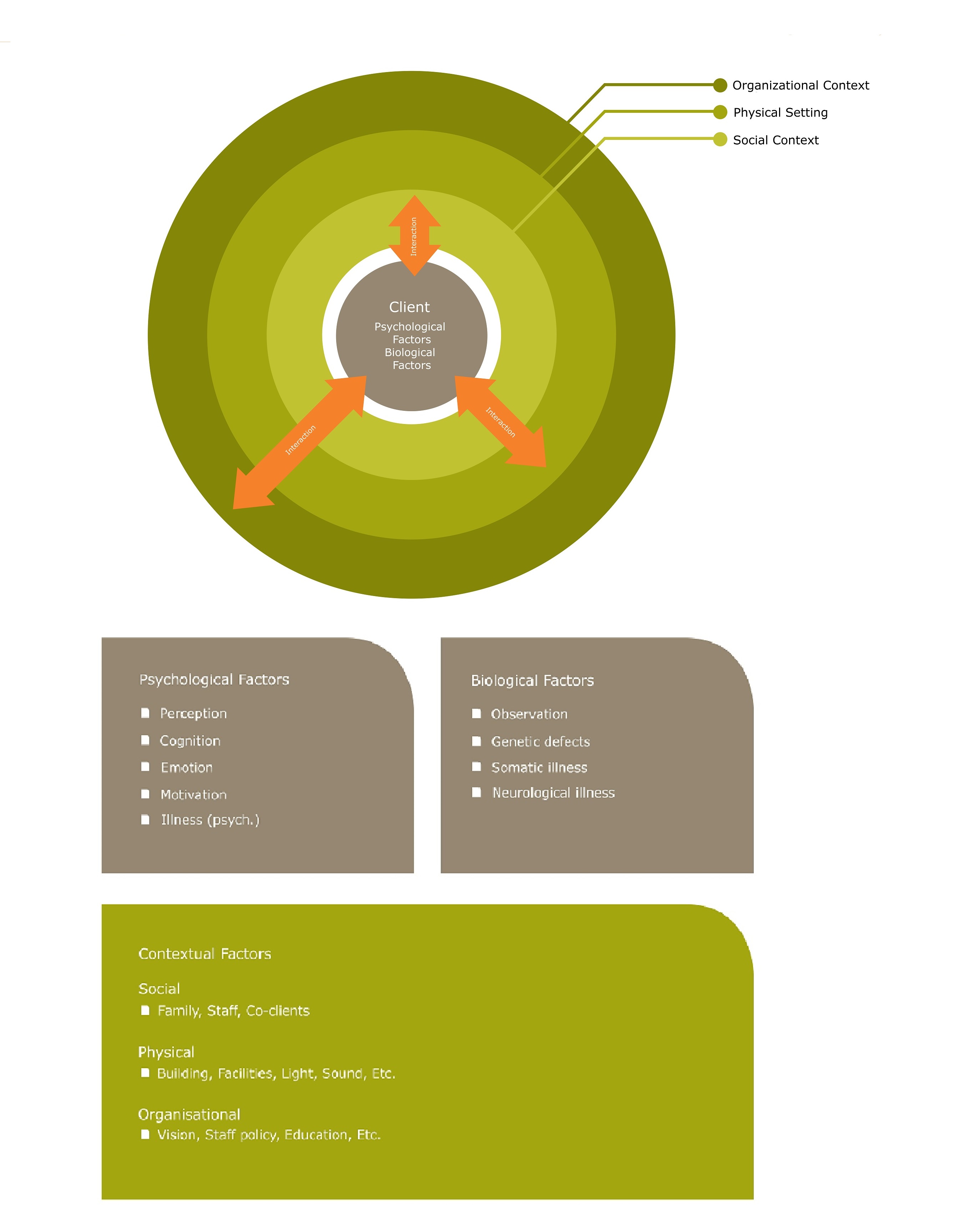
Challenging behaviour always occurs in a specific context, so it is important to identify the factors which cause or perpetuate the behaviour in both the client and their environment, and in the interaction between the two. On the individual client level, CCE distinguishes between biological and psychological factors that can cause or perpetuate challenging behaviour. On the contextual level, CCE makes a further distinction between the social setting, the physical setting and the organization involved.
Biological factors include problems with, for example: sight or hearing, syndromes and genetic defects, physical conditions that cause pain or discomfort or fatigue, neurological conditions or problems such as degenerative disorders, psychiatric conditions and brain injury. Psychological factors include problems with perception, cognition, emotion and motivation. Factors in the context/environment that cause and perpetuate challenging behaviour may include factors in the social setting (such as family, staff or fellow clients), the physical setting (such as the building, decorations, light or sound) and the organization (such as its stance regarding challenging behaviour, personnel policy or training).
To explain or understand challenging behaviour and to be able to intervene effectively, it is always necessary to look at the individual client and their specific context. CCE believes that this must be done systematically in a cyclical process, starting with a comprehensive assessment of the client, followed by the formulation of an hypothesis, then interventions based on the assessment and hypothesis, and finally the evaluation of the effectiveness of the interventions in terms of the result for the client in question.
This is illustrated in the following figures: